Red Team vs Blue Team: Understanding the Core of Cyber Defense
In cybersecurity, the terms Red Team and Blue Team describe two sides of a simulated battle between attackers and defenders. These exercises help organizations test their resilience and improve their ability to detect and respond to real threats.
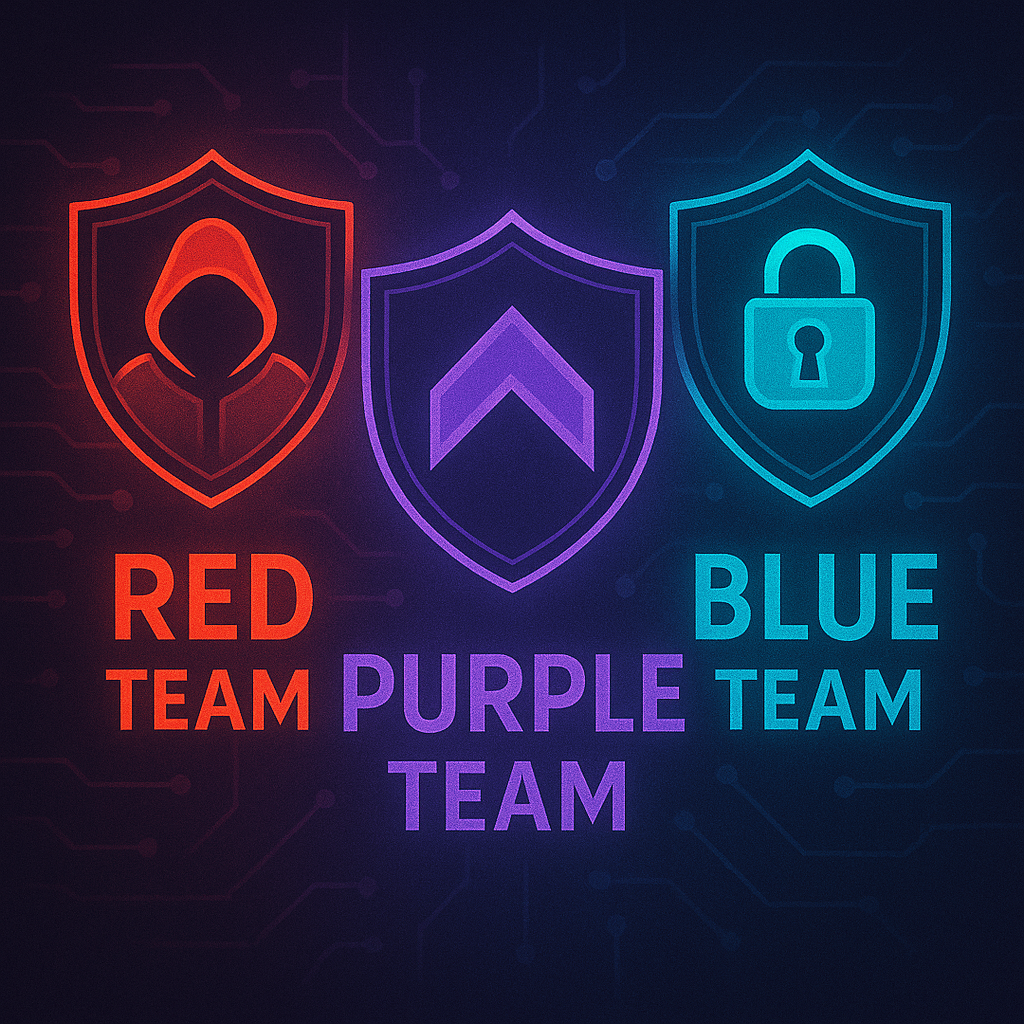
🟥 Red Team – The Attackers
The Red Team simulates real-world adversaries to uncover hidden weaknesses and test the limits of a system’s defenses. Their mission is to breach, persist, and evade — not to cause damage, but to reveal what a real attacker could do.
They’re the offensive side of cybersecurity, working to outsmart defensive teams by exploiting vulnerabilities before actual threats can.
🔍 Typical Activities
- Penetration testing (internal and external)
- Social engineering, including phishing and pretexting
- Physical security bypasses (e.g. badge cloning, tailgating)
- Custom malware and payload development
- Establishing persistence and evading detection
- Emulating adversary TTPs (Tactics, Techniques, Procedures)
🎯 Common Engagements
Red Teams are brought in to:
- Test incident response and SOC effectiveness
- Evaluate Zero Trust architecture, EDR, and AV resilience
- Simulate assumed breach or insider threat scenarios
- Identify gaps in detection, logging, or response
- Provide executive teams with a realistic attack simulation
These are long-form, goal-based operations — often running stealthily over weeks or months.
🛠️ Skills & Tools
Red Team operators combine technical depth, creativity, and stealth. Key skills include:
- Exploit development and scripting (Python, PowerShell, Bash)
- OS internals (Windows, Linux & MacOS),
- In depth knowledge of networking and protocols
- Tooling:
Kali Linux,Cobalt Strike,Metasploit,BloodHound,Mimikatz - Identity provider attacks and lateral movement
- Social engineering and phishing
- Antivirus/EDR evasion techniques
Backgrounds often include ethical hacking, offensive security research, or bug bounty hunting.
🧠 Threat Emulation & MITRE ATT&CK
Modern Red Teams use structured threat emulation to simulate advanced adversaries such as APTs (Advanced Persistence Threats) — not just random exploits.
They replicate the behaviors of real-world threat groups (e.g. APT29, FIN7, Lazarus Group) using the MITRE ATT&CK framework — a globally recognized matrix of attacker tactics and techniques.
🔗 Benefits of MITRE ATT&CK-aligned Red Teaming:
- Standardized mapping of attacker behaviors
- Identifying detection coverage gaps
- Enabling Blue Teams to fine-tune alerts and response
- Improving overall cyber defense posture
Popular threat emulation tools include:
Atomic Red TeamCALDERASCYTHERed Canary’s Detection Lab
🟦 Blue Team – The Defenders
The Blue Team forms the backbone of an organization’s cyber defense. They are the first line of detection and response, working continuously to monitor, analyze, and defend systems from real-world threats and simulated attacks alike.
They don’t just respond to alerts — they build, tune, and improve the entire detection and defense ecosystem.
🔐 Core Responsibilities
- Continuous monitoring of logs, alerts, endpoints, and network traffic
- Threat detection, including anomaly spotting and behavioral analytics
- Incident response, including triage, containment, and remediation
- Forensics and root cause analysis of past attacks
- Deploying and maintaining security controls, like EDR, SIEM, firewalls, and more
- Security hardening and proactive configuration tuning
- Creating and refining playbooks and runbooks
🛡️ Typical Tools & Technologies
Blue Teams rely on a combination of visibility, automation, and intel. Their tech stack may include:
- SIEMs:
Splunk,ELK Stack,QRadar,Microsoft Sentinel - EDR/XDR:
Cynet,CrowdStrike,SentinelOne,Defender for Endpoint - SOAR platforms for automating responses:
n8n,Shuffle,Tines,DFIR ORC - Network monitoring:
Zeek,Suricata,Wireshark,Security Onion - Forensics:
Volatility,FTK,Autopsy,Velociraptor - Threat intelligence feeds and platforms:
MISP,SANS ISC,Crowdsec
🎯 Key Objectives
Blue Teams aim to:
- Detect intrusions early, ideally in the initial access or reconnaissance phase
- Contain and remediate before damage is done
- Minimize dwell time and reduce blast radius
- Continuously learn from incidents to prevent repeat attacks
- Build resilient systems through proactive defense
🧠 Skills & Mindset
Effective Blue Team members combine technical knowledge with analytical thinking. Key skills include:
- Deep familiarity with log analysis and alert tuning
- Understanding of network protocols, endpoint behavior, and OS internals
- Ability to investigate artifacts: processes, connections, registry, memory
- Knowledge of MITRE ATT&CK mappings and detection engineering
- Strong documentation and playbook creation skills
- Constant collaboration with Red Teams and Purple Teams
📊 Threat Detection Frameworks
Like Red Teams, Blue Teams also align with the MITRE ATT&CK framework, but from a detection and defense perspective.
They map detection rules to specific ATT&CK techniques, using:
- Sigma rules, YARA, or custom correlation logic
- Detection-as-code and automated testing
- Threat hunting campaigns aligned to real-world threat actor behavior
Many mature Blue Teams also adopt Threat-Informed Defense principles and collaborate with Red/Purple teams to close visibility gaps.
🟪 Purple Team – The Collaborators
A Purple Team bridges the gap between the offensive (Red) and defensive (Blue) sides of cybersecurity. Rather than operating as a standalone unit, Purple Teams act as enablers of collaboration, turning competition into shared learning.
Their mission is to maximize the value of Red Team insights by ensuring Blue Teams can rapidly detect, respond to, and improve against those same tactics — creating a constant feedback loop of improvement.
🧩 What They Actually Do
- Coordinate and facilitate joint exercises between Red and Blue
- Translate Red Team TTPs into actionable detection logic and defensive improvements
- Help the Blue Team develop detections, alerts, and playbooks based on real attacker behaviors
- Work with the Red Team to refine attack scenarios and test detection coverage
- Monitor engagements and track gaps across people, process, and tech
- Run purple teaming workshops, tabletop exercises, and detection validation
🔄 Continuous Feedback in Action
Purple Teams aren’t just a bridge — they’re the feedback engine of a mature security program. They:
- Enable shared visibility across attack chains
- Help implement continuous attack simulations and defensive tuning
- Track MITRE ATT&CK coverage across the kill chain
- Ensure the lessons of each engagement are captured and implemented
Some orgs form dedicated Purple Teams; others create temporary Purple roles during specific exercises or campaigns.
🛠️ Tools & Frameworks
Purple Teams use a blend of offensive and defensive tooling to simulate, monitor, and measure. Common tools include:
MITRE CALDERA,Atomic Red Team,Invoke-AtomicRedTeamSigma,YARA, and custom detection-as-code frameworksAttackIQ,SCYTHE,Vectr,PurpleSharp- Integration with SIEM, EDR, and SOAR platforms to validate detections
- Purple Team dashboards to track visibility, gaps, and improvements
🧠 Skills & Collaboration Mindset
Purple Teamers need a hybrid mindset:
- Understand Red Team tactics and tooling
- Know how to build detections and response mechanisms
- Facilitate cross-team communication
- Act as translators between offense and defense
Their superpower is alignment — turning individual team strengths into a unified security strategy. er words, the Purple Team’s mission is to share intelligence, tools, and techniques to help both sides grow stronger together.
⚔️ Summary
| Team | Role | Focus |
|---|---|---|
| Red Team | Offensive | Simulate attacks to find weaknesses |
| Blue Team | Defensive | Detect and respond to attacks |
| Purple Team | Collaborative | Improve coordination and effectiveness |
Final Thoughts
Red Teams sharpen the sword.
Blue Teams strengthen the shield.
Purple Teams make sure both work together.
In mature security programs, all three play a vital role — creating a cycle of continuous improvement and resilience against ever-evolving threats.